
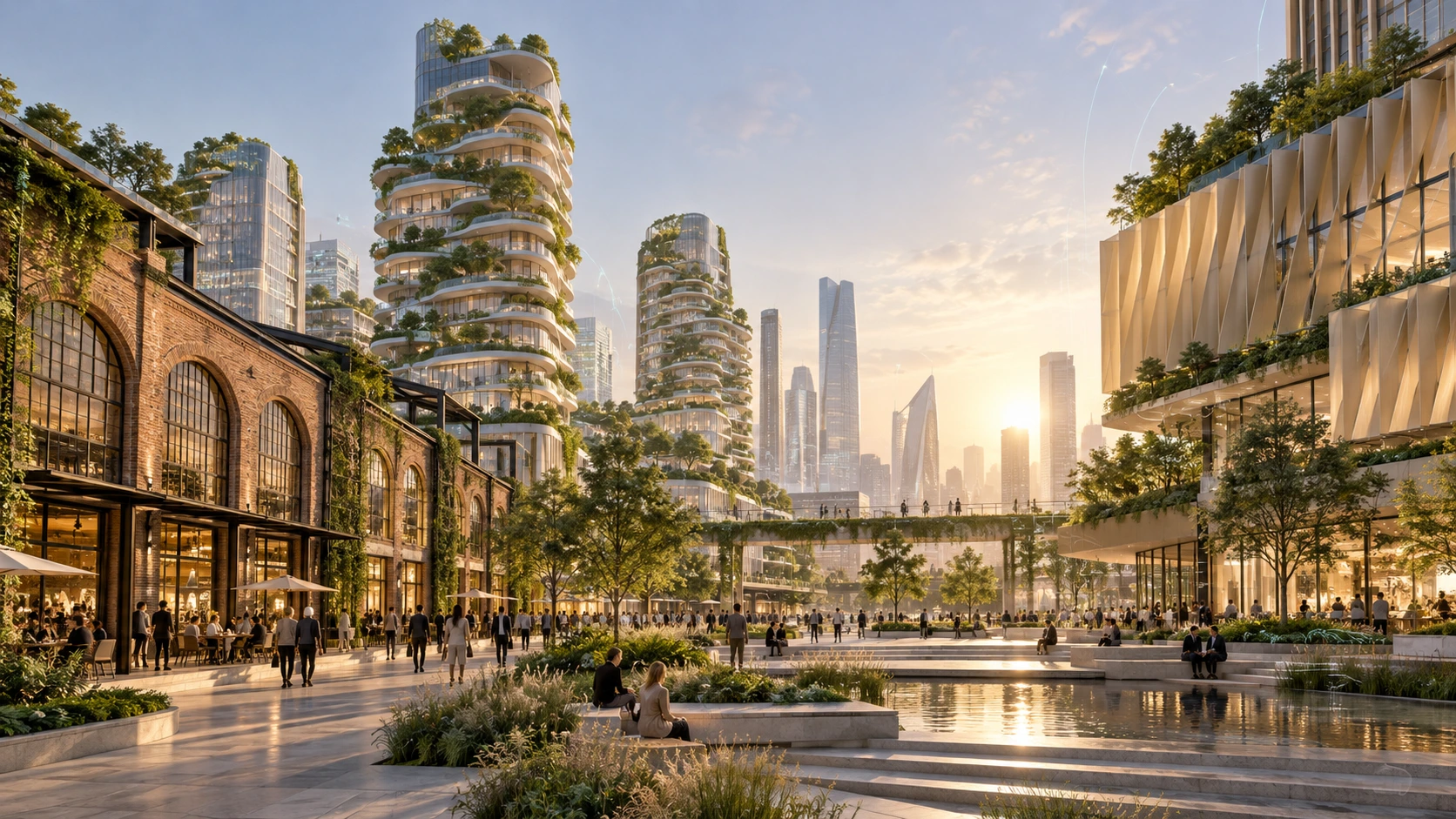
A practical look at the forces likely to shape architecture in 2027 — from AI-assisted workflows and adaptive reuse to climate intelligence, mixed-use development and a new emphasis on long-term value.
Key Takeaways
- AI is moving from image-making toward option testing, research and decision support.
- Adaptive reuse is becoming a design and development strategy, not only a sustainability statement.
- Mixed-use and district-scale thinking are replacing isolated-object architecture in many growth markets.
- Climate performance and long-term operational value are increasingly part of design quality.
- Architectural recognition is shifting toward projects that can explain both design excellence and measurable relevance.
1. AI-assisted design becomes part of the normal workflow
The most important AI shift is not the production of spectacular concept images. It is the gradual integration of machine-assisted research, precedent analysis, option generation, visualization, communication and design testing into everyday practice. The competitive advantage will come from knowing when AI improves judgment and when it merely accelerates noise.
In 2027, studios that can clearly describe the human role in an AI-assisted process will be better positioned than those that treat AI as a black box. Authorship, curation and accountability remain human responsibilities. The interesting question is no longer whether AI was used, but how intelligently it was used.
2. Adaptive reuse moves into the center of design strategy
Existing buildings are increasingly being viewed as assets to reinterpret rather than obstacles to clear away. Adaptive reuse can combine cultural continuity, embodied-carbon awareness, faster delivery in some contexts and a strong narrative identity. It can also create distinctive commercial value because the resulting spaces are difficult to reproduce from scratch.
The design challenge is to avoid treating reuse as cosmetic preservation. Strong adaptive projects reveal the logic of the existing structure while making decisive new interventions. They balance respect and transformation rather than choosing one at the expense of the other.
3. Mixed-use becomes a city-making tool
Mixed-use development is evolving beyond the simple stacking of retail, offices and apartments. The stronger model is a connected urban ecosystem: housing, work, hospitality, culture, landscape, mobility and public space reinforcing each other across the day.
For architects, this changes the scale of the problem. The key questions become circulation, transitions between public and private territory, ground-floor activation, climate comfort, phasing and identity across multiple buildings. The quality of the spaces between buildings matters as much as the objects themselves.
4. Climate intelligence becomes visible in the architecture
Environmental performance is most compelling when it shapes the architecture itself. Orientation, shading, thermal mass, landscape, water strategies, facade depth and natural ventilation can create identity while reducing dependence on mechanical solutions.
In warm climates, this may mean deeper thresholds, shaded courtyards and carefully calibrated envelopes. In colder climates, compact forms, daylight strategies and envelope performance may dominate. The broader trend is away from sustainability as a checklist and toward climate response as a design language.
5. Materials become strategic rather than decorative
Material choice is becoming more closely connected with provenance, durability, maintenance, carbon, repairability and local supply. This does not mean architecture will become visually austere. It means material beauty will increasingly be judged alongside material intelligence.
Expect more attention to low-carbon concrete alternatives, timber and hybrid systems where appropriate, recycled content, bio-based materials, high-performance envelopes and locally available finishes. The strongest projects will communicate why a material was chosen, not merely where it was applied.
6. Residential architecture focuses on quality of everyday life
After years of emphasis on iconic form, residential design is returning to basic but difficult questions: daylight, privacy, storage, acoustic comfort, flexibility, outdoor space, shared amenities and the relationship between home and neighborhood.
Luxury will increasingly be expressed through spatial generosity, calm, craftsmanship and resilience rather than decorative excess alone. In mass housing, even small improvements in plan logic and communal space can produce significant value at scale.
7. Recognition will favor projects with a clear point of view
As more projects are published and more images are generated, visual novelty alone becomes less persuasive. Projects that stand out tend to have a clear argument: a precise response to place, a meaningful innovation, an unusually resolved user experience or a convincing way of integrating technology and design.
For studios entering international awards, this means the submission should explain the project in a way that makes the design intelligence legible. Good work deserves good communication.

WAIDE View
WAIDE sees 2027 as a transition from image-led design culture toward evidence-led creative intelligence. The strongest architecture will still be emotionally powerful, but it will also be able to explain its decisions, its relevance and the value it creates.
Frequently Asked Questions
What are the biggest architecture trends for 2027?
AI-assisted workflows, adaptive reuse, mixed-use development, climate-responsive design, material intelligence and stronger focus on long-term value are among the most important themes.
Will AI replace architects?
The more realistic near-term change is augmentation rather than replacement. AI can accelerate research and iteration, but responsibility for judgment, authorship, context and delivery remains human.
Why is adaptive reuse becoming more important?
It can preserve cultural value, reduce unnecessary demolition, unlock distinctive spaces and respond to environmental and economic pressures at the same time.